Sizing is one of fashion retail’s most persistent profitability problems, and one of the least visible. This isn’t the kind of sizing issue that’s realized in the fitting rooms; it occurs before the customer even gets there, because their preferred size wasn’t even available to begin with.
Fashion retailers are slowly leaking profit through missed conversions, skewed data, early markdowns, and off-kilter size curves, season after season.
Here, we break down four ways your size curve may be costing you more than you realise, and the solutions to get you back on track.
1. You’re measuring stock, not size availability
While most retail businesses track product availability, fewer than you think track size availability, which is the metric that actually drives conversion.
When a new product launches, size availability is at 100%. When a key size sells out, it drops to 80%. For popular products where a single best-selling size dominates demand, a size break can push effective availability as low as 40%.
The Pareto Principle tells us that 80% of sales come from 20% of the range. So, when a size
breaks on one of those hero products in the first two weeks after launch (your peak traffic window), the impact on sell-through is significant.
Size Availability’s Golden Rule: Every product should launch with enough depth to maintain 100% size availability for a minimum of two weeks. If that’s not achievable across the range, prioritise the products and sizes with the highest conversion rates.
2. Your buying data is reinforcing the wrong size ratios
Most merchandising teams buy by size using historical sales data. The problem? That data is shaped by out-of-stocks, and those out-of-stocks are invisible in a standard spreadsheet.
“Most inventory distortion stems from inaccurate purchase order quantities, driven by skewed sales data due to out-of-stocks at the store and size level. I estimate that manual buying using spreadsheets typically accesses only half of the data points available, and only a subset of those are fully accurate.” — Michaela Wessels, CEO and co-founder, Style Arcade.
The solution is True Rate of Sale: a methodology that corrects for out-of-stock distortion to reveal the actual underlying demand by size. When you buy to demand rather than to history, your size ratios become more accurate, and the compounding inaccuracy across seasons unwinds.
3. You’re not reading the cultural signals fast enough
Size curves aren’t static. Right now, we’re seeing consumer body profiles shift, and fashion silhouettes shift with them. And in recent years, two forces have accelerated that change faster than most buying cycles can track.
GLP-1 medications now reach over 12% of the US adult population — and that share is growing. Retailers like Lafayette 148 are seeing customers downsize by three or four sizes at once. Lululemon publicly noted missed opportunities in smaller sizes in 2024. While Rent the Runway reports customers moving toward body-hugging styles at a rate not seen in 15 years.
Simultaneously, the revival of Y2K and 90s minimalism has reshaped demand curves, particularly in denim and occasion wear. According to e-commerce data firm Particl, “Skinny Leg” styles rose 238% in average revenue in 2025, and “Slim Fitting” items saw a 75% increase in revenue contribution.
Brands that update their size curves ahead of the data, and before creating OTB budgets, will be the ones to convert. Those who wait to see it in sell-through reports will find themselves overstocked in the middle of the curve and chasing sizes they didn’t buy enough of.
4. You’re treating fringe sizing like a trend buy
The plus-size market is projected to reach USD 583 billion by 2035. The opportunity is clear. But many brands approach extended sizing the same way they approach a trend buy: testing with minimal depth, pulling back when early results are slower than expected, and concluding the market doesn’t exist for them.
That’s not a fair test, because extended sizing requires the same depth of investment as a core category: in buy quantities, in product imagery, in the shopping experience. Without that foundation, conversion data will always look weak.
The smarter approach: use a data-led framework before committing. If end sizes account for more than 15% of sales in a typical 7-size curve, there’s a demand signal worth testing. Go deeper on attribute-level data (which silhouettes, colours, and necklines perform in end sizes) to build a targeted fringe assortment rather than a blanket extension.
Download The Retailer’s Guide to Getting Sizing Right for the full framework on size curve accuracy, True Rate of Sale, fringe sizing decisions, and how to navigate the shifting cultural landscape
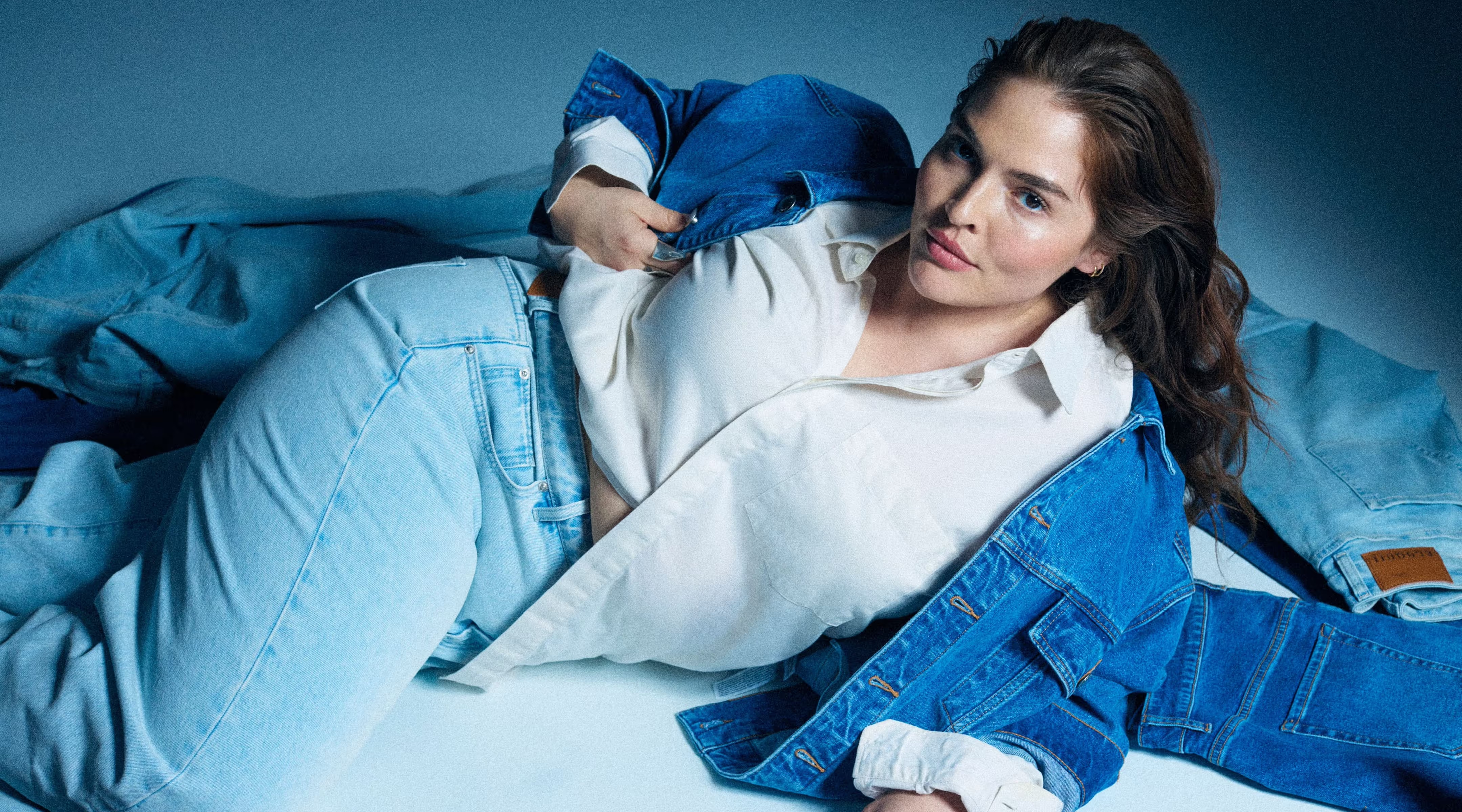
Image credit: Eloquii