When I started in the industry, great buyers and merchants asked the right questions, found the opportunities and took action.
And this is still true today. Somehow, though, even with all the advancements in technology, the ability to even get answers to the questions has become harder, not easier.
There are so many businesses that are still struggling with fundamental retail questions, and buyers and planners are spending the majority of their time just pulling together reports.
Fashion retail doesn’t just need automation and the numbers crunched; it needs systems that have intelligent merchandising layered in to enable the questions and workflows that fit each individual business. This is what I spoke to during my workshop “The End of Generic AI: Why Fashion Needs Brand-Specific Intelligence” at Magic by Informa, Las Vegas.
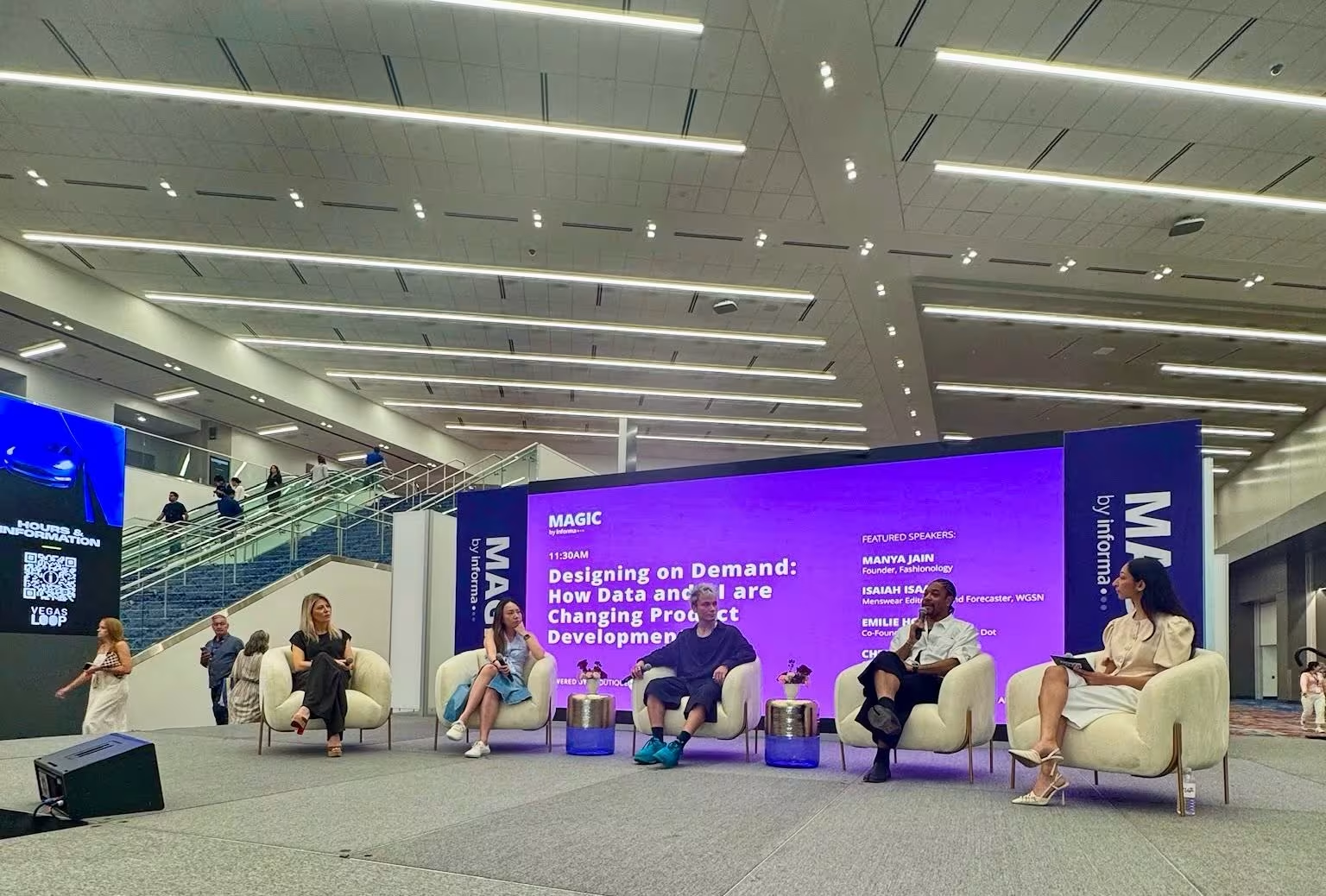
Here are my tangible takeaways directly from the session, including how to simultaneously lead with AI and human development, be focused on the right value-add tasks, and why the MCP spells the end of generic LLM‘s being used by fashion retailers.
Why Generic AI isn't enough in fashion retail
MCPs (Model Context Protocols) are becoming the new standard for retail software. As an MCP is a connection between your merchandise intelligence layer and your business tools - your generic AI LLM of choice is then just the interface you’re using to query that data.
Some of the benefits of this MCP connector between your data analytics layer include:
- Not having to upload static files or multiple time frames when you want to query comparable or like-periods or styles.
- Having a connected merchandise intelligence layer means you don’t need to explain all of retail math to the LLM. If you ask, "Show me sell-through by category this season," the LLM doesn't need to know how to join sales, stock, purchase orders, retail calendars and all the underlying merchandising logic.
- Flexibility. With a connected merchandise intelligence layer, you’re not tied to one LLM. You’re free to switch between them as you please.
Why most retail AI projects fail before they create value
The research behind why retail AI projects fail is that data readiness is lacking across the industry. Practices that are not setting you up for success - AI or not - if you want a complete and accurate view of product performance in your business.
"Good AI needs two things: clean data and commercial context."
Recycling product codes or not putting purchases on the system as soon as they've been placed are probably the most common ones we see tripping people up. Also, pricing - if a discount is not permanent, applying a discount or promotion rather than changing the RRP.
But a critical piece that a lot of businesses are underestimating is the time and effort of training the model on merchandise planning business logic and the rules that are bespoke to your business.
Fashion retail isn't just about asking for a number – it's knowing exactly how that number should be calculated. What counts as sell-through? Which stock snapshot should be used? How do you account for weeks of cover, retail calendars, pre-orders, cancellations, incoming stock or different product hierarchies?
If you're building AI yourself, all of that logic has to be defined, tested and maintained.
Good AI needs two things: clean data and commercial context.
That's why your product architecture and merchandising logic are becoming AI infrastructure.
Get the foundations right, and AI accelerates your decisions. Get them wrong and AI simply makes incorrect decisions faster with unreliable information.
Fashion needs AI that understands your products and trading patterns
Having an MCP that is built on a merchandise intelligence layer means you then have best-practice prompts calling on validated merch math, which not only saves you time but actually gives you the right results.
The merchandise intelligence layer is where you’re holding all of the calculations and understanding of your trading cadence so you can rely on it to give you the true story in your data.
Importantly, the human is still the decision-maker, someone who is applying that commercial judgment and taking accountability and action.
The three data foundations every retailer should fix before investing in AI
Here’s what you should be putting your data hygiene efforts towards:
- Connected data
Ensure all data points are captured and are accessible in one place; make sure your purchase orders are logged on time with updated ETAs, and that your pricing reflects promotions and red pen discounts accurately.
- Structured data
Good attribution is the key to surfacing up key stories and insights from your data. At the most basic level, ensure a high-level category or product type is assigned to all products. Utilise Style Arcade’s AI image attribution to help here.
- Retail and brand context
Align on your definition of target metrics and brand context you’ve defined, like launch and markdown logic, and that everyone on the team is on the same page.
How to identify where AI will deliver the biggest ROI
Follow the process below to determine what you’re actually going to gain from implementing AI into your business,
What you’re wanting to achieve is:
- Time savings
- Consistency in best practice approach
- Commercial Outcomes on sales, margin and inventory coverage
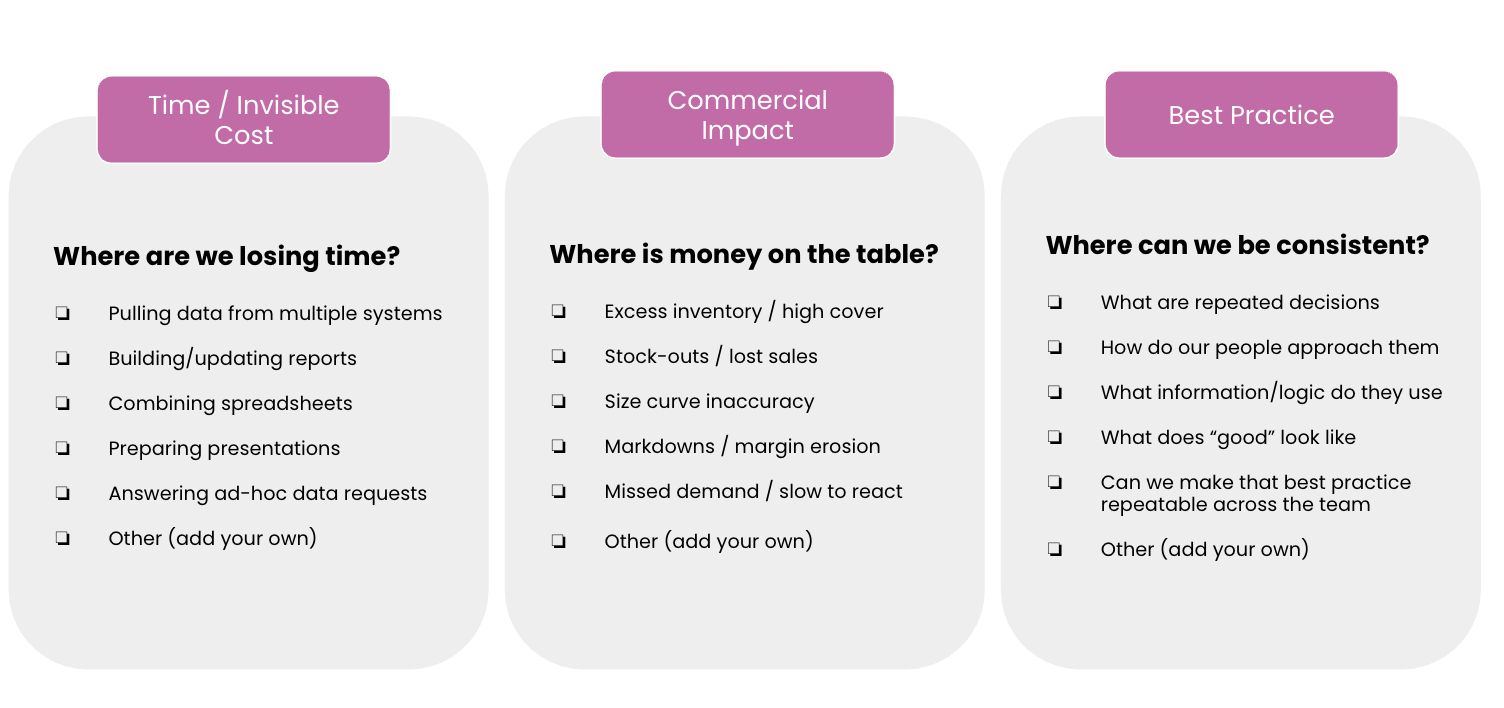
Look for where you're losing time
Timebox your calendar: Where are you or your team spending hours pulling data, combining spreadsheets, updating reports and preparing information before they can actually make a decision?
The invisible cost
This is a follow on from that lost time - what questions aren't we even asking because getting to the answer takes too long? Sometimes the biggest opportunity for AI isn't helping you make a better decision. It's giving you the capacity to make a decision you weren't making at all.
Look for where there's commercial opportunity
Review your trailing and leading indicators to understand where the opportunity lies. Metrics like size curve accuracy, true rate of sale and cover - what is the $ gap between actuals vs target.
As an example identifying aged stock that has high weeks of cover that you could move through to free up stock to invest in newness.
Look for the questions you're answering again and again
Take a note of all of the questions you’re continually asking that could be automated or turned into repeatable workflows. You want to make sure you’re applying a best-practice approach to these each time, accounting for all the context in your business. Examples include Monday Trade Pack or your Hindsight Reviews.
How to prepare your merchandising team for AI adoption
But there's another side of AI adoption that's just as important - what does this mean for our people?
Teams are still wrangling cumbersome ERP’s, pulling data from multiple sources just to pull together a pack and using BI cubes that don’t natively calculate basic fashion metrics. The ‘system’ is not set up to enable merchants to deliver value.
The goal isn't simply to make the existing job faster. It's to create more time for the skills that actually deliver commercial outcomes. Buyers weren't hired to build reports and planners weren't hired to reconcile spreadsheets; they were hired to make commercial decisions.
"The goal isn't simply to make the existing job faster. It's to create more time for the skills that actually deliver commercial outcomes."
Think about how much of the merchandising workflow looks like this today:
Gather the data → Prepare the reports → Build the trade pack → Find the insight → Make the decision
AI allows us to compress that:
Ask the question → Review the insight → Take action → Influence the outcome
This doesn't make buying and planning expertise less valuable. Because the value of the role shifts from producing information to interpreting, deciding and influencing.
Preparing your team for AI isn't just about teaching people how to use Claude or write a better prompt. It's about developing the human capabilities that become even more valuable when the manual work starts to disappear.
Judgement
- Identification “Do you spot the right issues at the right time?” Either through analysis or intuition
- Analytical Rigor “Do you think about and analyse the issue effectively?”
- Articulation “Do you talk about the issue to generate understanding and commitment?” Framing it in a way that identifies the key issues for others.
Drive
- Impact (Internal): “Do you have the desire to make a difference/contribution?” not ambition for its own sake, it is an internal orientation; a depth of motivation
- Confidence (Internal): “Do you believe in your ability to do what needs to be done (and tackle challenges)?”
- Initiative (External): “Do you create and grasp opportunities for yourself, others and the business?”
Impact
- Self-Awareness: “What do you know about yourself?” Leverage strengths, remain vigilant on detail whilst assessing the bigger picture
- Environmental Radar: “What do you understand about your environment?” At the industry, organisational, brand and team levels
- Shaping: “How do you leverage your insight and understanding to have an impact?” How can you utilise and connect with others to gain a broad range of influence
Because in an AI-enabled merchandising team, the skill isn't going to be who can build the best spreadsheet. It's who knows the right question to ask, who can challenge the answer, and who knows what to do with it.
That brings us right back to where we started. Great buying and planning was and still is about asking the right questions, finding the opportunity and taking action.