For fashion brands, it is clear that having no AI strategy is not an option: the productivity gap between teams using AI and those that aren't is already widening. The Model Context Protocol (MCP) is the next step in the AI retail movement, for more connected, data-driven decision-making across buying, planning, merchandising and digital commerce.
As Model Context Protocols (MCPs) gain credibility as the industry’s newest desirable for the top-tier tech stack, it pays to understand what separates the retail MCP from standard agentic AI.
Learn everything you need to know about fashion MCPs, why generic LLMs won’t make the cut, and how bespoke AI fashion assistants can truly deliver without your data ever contributing to someone else's AI model.
What is Model Context Protocol (MCP)?
Model Context Protocol, known as an MCP, acts as the neutral standard for connecting AI applications to live data systems. Think of it like a universal travel adaptor; instead of needing a new adaptor for every country, you just have one that all appliances, anywhere, can plug into.
An MCP is not software, but a standardized connector of information, like data sources and workflows, to large language models (LLMs) like Claude Code, Claude Cowork and ChatGPT for them to access the data and perform tasks. Without an MCP, for AI tools to communicate with different software platforms, a custom integration would be required every time.
Why use an MCP instead of an API?
A direct API connection can give your LLM access to your software, but it is less secure and reliable than an MCP. This is because the LLM needs to manage authentication keys and work out how to actually use the API, which it may not consistently remember. Most importantly, an API connection has no built-in business context, relying on textbook retail maths rather than real-world retail experience.
Think of the MCP as an API plus user-manual for the LLM:
- Provides a more secure, structured way for the LLM to interact with the system
- Gives the LLM guidance on how to use the software and its data
- Provides the business and retail context needed to interpret the data correctly
- Built on real-world retail logic, rather than the LLM's theoretical knowledge
Why a generic MCP limits merchandising decisions
Imagine giving a junior buyer or planner access to a data warehouse and asking them to figure it out themselves. They’d probably download everything into Excel, spend hours joining and formatting the data in V Lookups and pivot tables, and only then start asking the right questions.This is similar to connecting an LLM to a generic MPC. However, an MCP shouldn’t be working its way through huge amounts of raw data to answer a simple question. Like a junior planner, it may speak the language and understand basic reports, but it would still have to figure out:
- Which tables contain the right information
- How different data sets connect
- Which data needs to be combined
- How each metric should be calculated
- How the data changes over time
- Whether different data sets are duplicating each other
The MCP would have to relearn all the organizational and retail context needed to make sense of the data, where it can easily make mistakes along the way. Style Arcade’s MCP in comparison also speaks the language of buying and planning, however the data is already joined, structured and prepared so the LLM can focus on answering the question rather than figuring out how the data works.
The addition of Style Arcade’s MCP to an LLM like Claude Desktop, means the data can be collated, joined and queried using simple language. It’s less complex, with fewer opportunities for mistakes, and more accurate answers.
This is especially important for fashion-specific queries like sell-through, size availability and other retail metrics, where connecting an generic MCP and LLM to raw data isn’t enough.
AI agents and ownership
Any business looking to give their team AI capability needs to think beyond individual software tools. End users shouldn’t be working across five chatbots and five siloed software and service applications.
To get the most productivity, you want to give each employee an agent. That agent can then connect to all of your systems and help them work across different workflows.
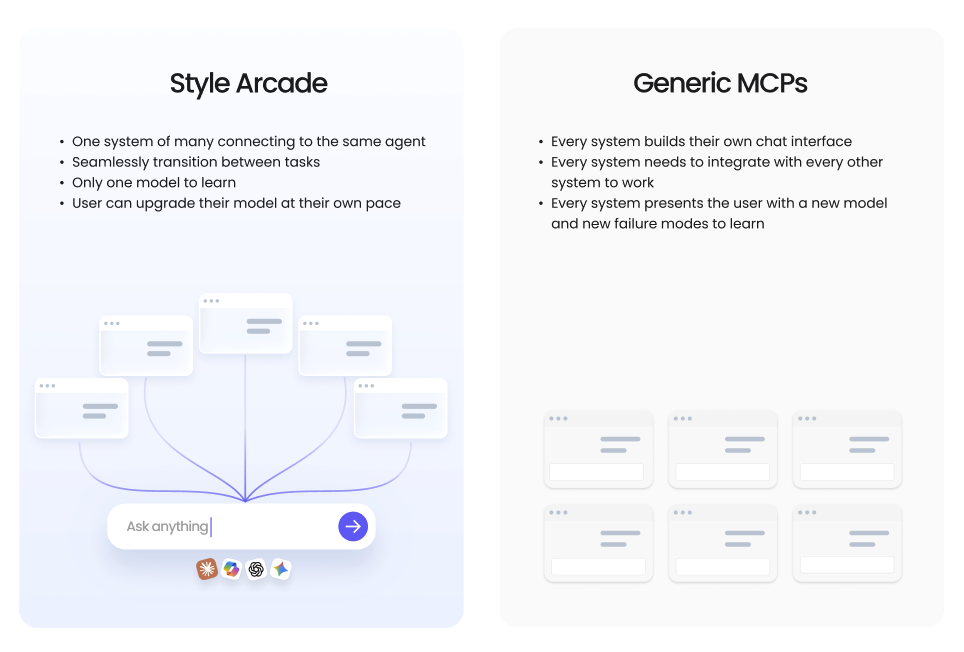
This raises an important question for SaaS platforms: does the platform own the agent, or does the user own the agent? The data is clear - the fashion teams we speak to that are getting the most real value out of AI are all using Claude Desktop or similar.
Data protection: Private vs Third-Party
If you are going to own the agent, you then need to consider whether you’re going to leverage third-party inference or private inference.In other words: does Anthropic process my request, or does a private layer, like AWS Amazon Bedrock process my request? It’s the same model, but there are different cost structures and different security considerations.
If a brand used Claude within Style Arcade, for example, using the MCP means that anything that touches a brand’s own data is routed through AWS Amazon Bedrock. This allows fashion teams to get the full capability of Claude, but the difference is that it's running on Style Arcade’s own infrastructure, so the data is fully protected and not being shared anywhere else.
Should you train your own LLM?
Training your own LLM might sound like the most advanced option. But the better approach is to use the best models to do the least work.Rather than relying on one model to do everything, use the best models available and build automations around them. Having an LLM do all the work is expensive, ineffective and difficult to maintain.You’re constantly trying to keep up with:
- New model capabilities
- Failure modes
- Errors and inconsistencies
- Ongoing maintenance
Teams should be building a system that can adopt the latest models as soon as they’re released.
Benefits of Style Arcade’s MCP
LLMs understand the theory of buying and planning, however, understanding the theory isn’t the same as having the best-practice logic to apply it correctly.Think of an LLM like a fashion graduate who understands retail maths, but hasn’t actually worked through the real-world edge cases or experienced the failures first-hand that happen in retail businesses today.
Many things can go wrong in retail data:
- Products can have different identifiers
- Products can be set up at the style or color level
- Typos and inconsistencies can break joins
An LLM can attempt to work through these problems, but it hasn’t learned them through real-world experience. There is a major the gap between theory and practice. The Style Arcade MCP has already solved much of this complexity.
The data is correctly joined, the right transaction types are understood, and has the retail maths has been battle-tested across billions of dollars in revenue, for all edge cases and scenarios that an LLM wouldn’t know to look for.
So instead of asking the LLM to figure out how to prepare the data, join it correctly and calculate the metrics, the Style Arcade MCP handles that complexity. The LLM can focus on what it does best: Understanding the user’s goal, applying its reasoning, and delivering the right answer. The MCP gives the LLM real-world retail experience it doesn’t have on its own.
The MCP is the next step in the AI retail movement, for more connected, data-driven decision-making across buying, planning, merchandising and digital commerce.
Sign up to be the first to know when Style Arcade's MCP launches.