For fashion retailers, getting as close to your sales target as possible is now business critical.
As fashion continues to face an unpredictable landscape of rising costs, fickle consumer demand, and disruptive supply chain issues - forecasting, sales and budgets must aim for accuracy to keep the cash in flow. Whether it's an over-bought purchase order, a late delivery or constant stock-outs on best-sellers, cash flow blockages can cause havoc for fashion retailers of any size.
The key to success is to plan inventory and budgets with precision and to buy exactly the right amount of stock, in the right sizes, for the right locations to meet demand. Part of that relies on a sound Open to Buy figure. Discover everything you need to know about OTB; what it is, how to set your budget, and how to manage your OTB through the season.
What is Open to Buy (OTB)?
Open to Buy is a term used in retail, primarily within buying and merchandise planning functions. It refers to the stock a retailer needs to purchase in order to meet its sales target, whether that's the original sales budget or a more recent reforecast.
When you look at purchase order data, there are three layers:
- Purchase orders already received: stock that has come in
- Outstanding purchase orders: stock that's been ordered and is due to arrive
- Open to Buy: the additional stock you still need to buy to reach your sales target
That third figure is your Open to Buy.
Formula:
OTB = Sales + Opening Stock - Closing Stock
Why OTB matters
OTB is arguably the key number the buyer cares about: it's the number they need to go out and spend. It can be viewed across different metrics: in units, at retail value (the RRP), or at cost. Most commonly, it's looked at in cost terms, because that's the actual amount of money being spent to buy the stock.
Why is a WSSI also known as OTB?
Open to Buy is an output of the WSSI (Weekly Sales Stock & Intake) process. Once purchase orders are clean and up to date, the WSSI gives a genuinely clear view of what stock is on hand, what's confirmed incoming and when, and critically, what still needs to be bought. That gap is called the open to buy (OTB).
Open to buy is the amount of stock that still needs to be purchased to hit the sales target and maintain the right cover position. If the plan calls for ten weeks of cover but certain weeks are forecast to dip to seven or eight, the WSSI will show exactly how much additional stock is needed and in which weeks. That figure - the open to buy - is what the merchandise planner hands to the buyer as a brief.
Setting OTB at the start of the season
At the beginning of a season, everything is Open to Buy, no stock has been placed yet.
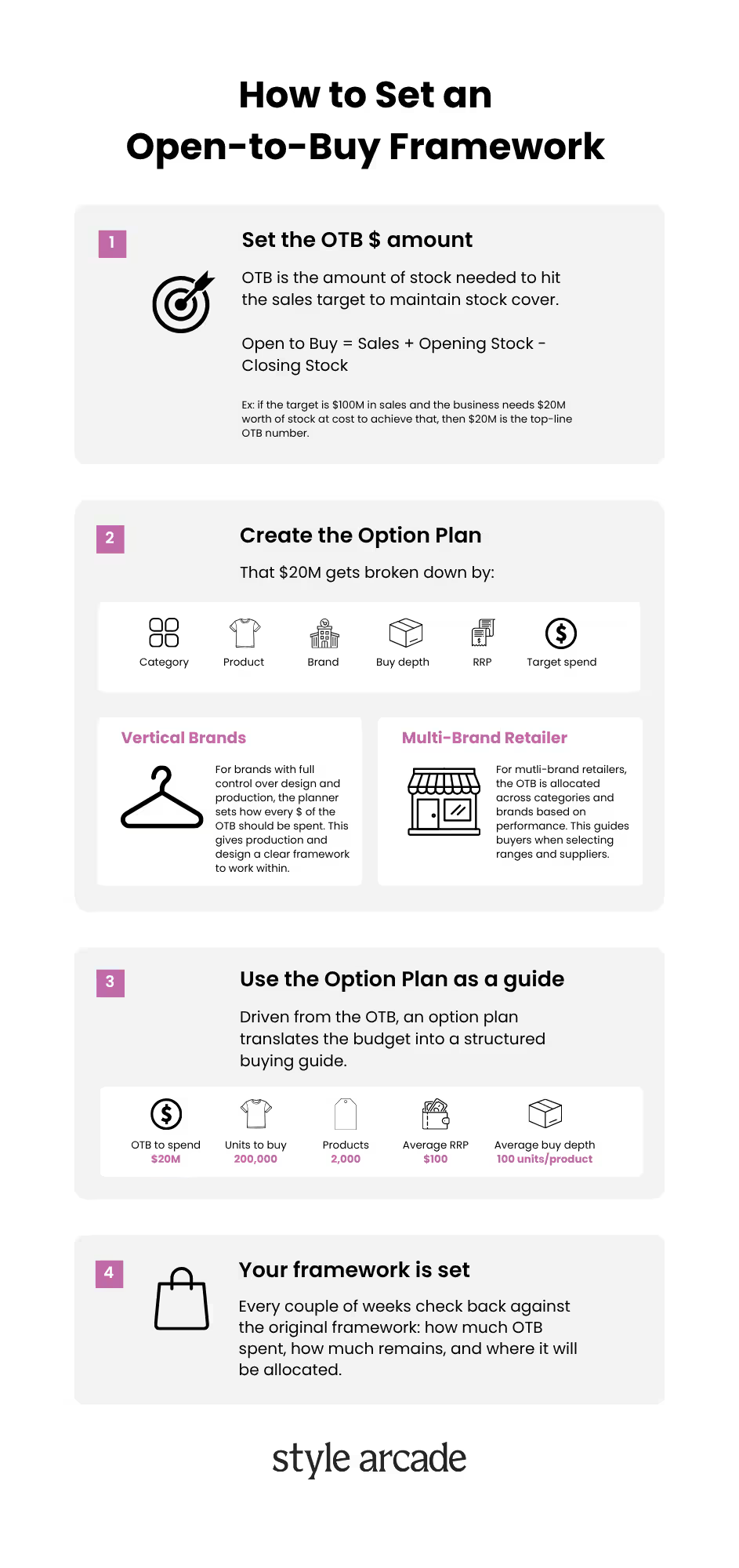
The planner's job is to set the total OTB figure based on the sales targets. For example, if the target is $100 million in sales and the business needs $20 million worth of stock at cost to achieve that, then $20 million is the top-line OTB number.
From there, it gets broken down. How should that $20 million be split across categories? Across brands? This is where it becomes more granular: how many products do you want to buy, at what average buy depth, and at what average RRP? This becomes known as the option plan, which is all derived from the OTB.
The Option Plan
Driven directly from the OTB, an option plan translates the budget into a structured buying guide.
For example: From $20 million to be spent, the business needs to buy 200,000 units across 2,000 products, with an average RRP of $100 and an average of 100 units per product.
All of this is determined upfront, before any stock is bought or designed. For a vertical brand, where the business has full control over what it designs and produces, there is a structured process for how every dollar of that $20 million should be spent. By category, by product, the planner sets out clearly how many options are needed and roughly how much should be spent on each, giving the production and design teams a clear framework to work within.
Setting OTB for multi-brand retailers
For a multi-brand retailer, the same logic applies, but with an added layer. The total OTB is split across brands, with each brand allocated a share of the budget based on historical performance. How did that brand sell through last year? What was its profitability? Should more or less money go into it this season?
The key difference with multi-brand buying is that the buyer doesn't have complete control over the range. You're buying what the supplier puts in front of you. If the range is strong, you might invest more; if it's weak, you pull back. That call ultimately sits with the buyer at the point of purchase.
Managing OTB through the season
Once the season begins and OTB starts to be spent, the focus shifts to reconciliation. Every couple of weeks, the team checks back against the original plan: how much has been spent, how much OTB remains, and where it will be allocated.
A key watch-out here is margin: overspending in a low-margin category can drag down the business’ overall margin and make it much harder to hit annual sales and profit targets.
Best practice, where the business model allows, is to not commit all of the OTB upfront.
A common approach is to spend around 60% before the season and hold back 40% for in-season trading.
That reserved budget allows the team to react to what's actually selling: spotting opportunities, placing repeat orders, and doubling down on best sellers. This kind of in-season trading is often where businesses really outperform their targets.
Of course, not every business has that flexibility. If lead times are long or supply chain constraints require committing to inventory upfront, there are still advantages to that approach. Placing higher volumes early can unlock better margins from suppliers, and stock can be shipped by sea rather than air, significantly reducing freight costs.
There's also room to negotiate flexibility on delivery timing with suppliers. Committing to an order of, say, 10,000 units doesn't necessarily mean all 10,000 arrive at once. Staggering deliveries helps manage warehouse capacity and, depending on payment terms, can also support cash flow by deferring when payment is actually due.
Managing OTB with fashion retail software
While small, straightforward fashion businesses and stores can operate using quarterly OTB in spreadsheets, brands and multi-brand retailers with complex assortments need WSSI capabilities to match the pace of modern retailing.
When choosing fashion retail software consider whether the features include:
- Precision forecasting: For fast-scaling brands acquiring thousands of new customers a month, it’s almost impossible to accurately and strategically forecast inventory without the right technology to support decisions at scale. Style Arcade’s product forecasting works by matching supply with demand and recommending order quantity, by size, for specific items.
- Automated budgeting capabilities: Advanced WSSI tools can provide proactive insights and recommendations and generate purchase orders. Style Arcade's digital assortment plan is visual, live and updates your OTB instantly as you buy.
- One platform for all departments: Everyone from your buyers and planners to your finance team should be on the same page. There needs to be clear visibility across the entire business to facilitate accuracy and efficiency.
Want more fashion merchandising step-by-steps?
Download the Merchandiser's Trade Playbook
A practical, action-first guide to improving product performance with product data, built to help fashion buyers and merchandisers understand what’s working, what’s not, and know exactly what to do next across metrics, channels, range and timing.