AI is becoming fashion's most useful assistant. But what’s an assistant without the know-how?
AI assistants have quickly earned their spot as the tech must-have for fashion brands and retailers, with efficiency-focused teams handing over the busywork to their favourite LLMs like, ChatGPT, Claude, Gemini and Copilot. Typically slower on the tech uptake, with spreadsheets still keeping buyers behind (or unable to work when Excel experiences an outage), it seems the appeal of fast, hands-free admin is hard to ignore.
But what happens when fashion gets lured into the promise of jobs getting done fast in lieu of executing them correctly? Simply put, an AI assistant that hasn’t been properly trained on fashion’s nuanced contexts – with all its merchandising logic, scenarios, product details, size ranges and pricing structures – is as good as a graduate who’s never built a range before.
Ssense found this out the hard way.
Again serving as the cautionary tale for e-commerce operations, the online retailer was just recovering from filing for bankruptcy protection when its AI sloppiness became fashion news-feed fodder. Though, with redundancies across its departments, perhaps one can be a little sympathetic to how the online retailer’s studio team fell victim to relying on AI to handle the groundwork.
Thousands of SKUs styled, shot and edited for upload has never been an easy task. Imagine the additional hours required to get the product online for selling when the personnel has been significantly depleted. AI, in this sense, was too good to be true. Unfortunately, it was.
Generate the product imagery in seconds? It may have been easy, but the result was unforgivably erroneous. Independent designer Reese Cooper took to social media to air his grievances about the discrepancies between the details of his products from his eponymous label, and how they emerged on Ssense's product pages.
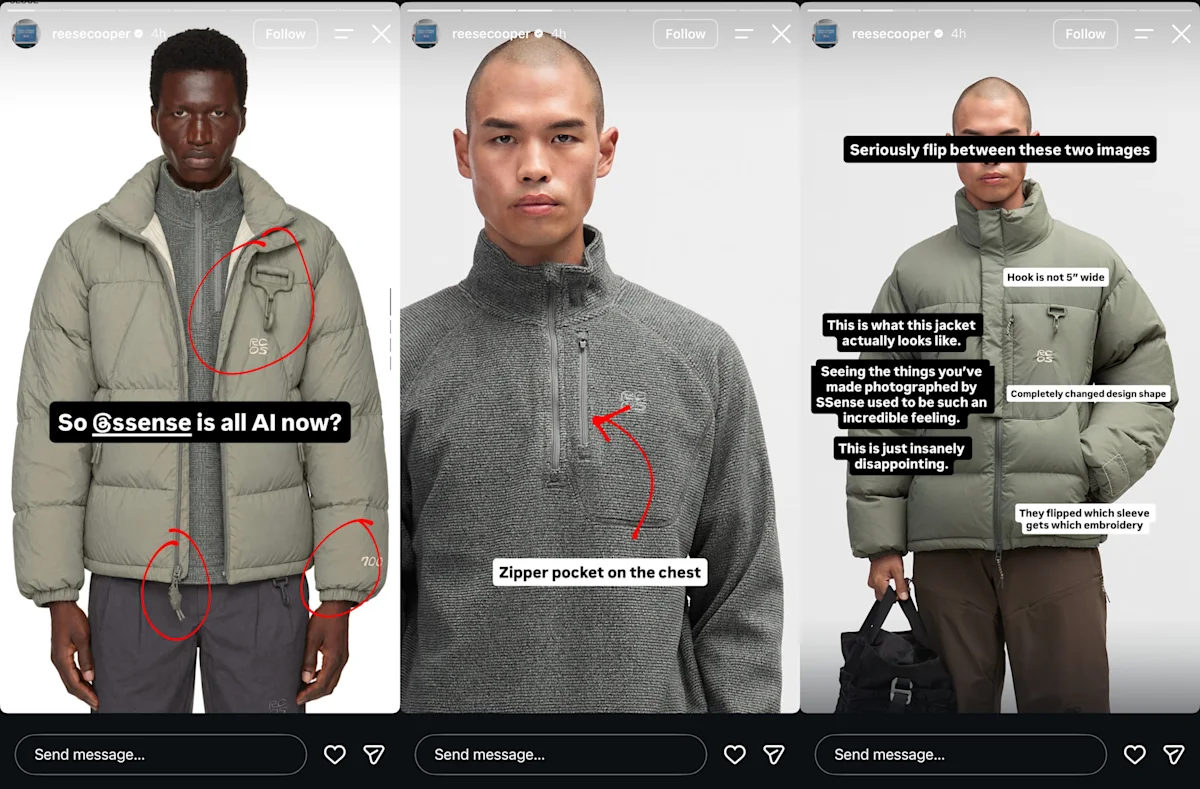
AI-generated imagery is just one aspect of fashion automations that toe the line between speed and accuracy. Beyond creative content, but similar in its actions, merchandising and buying teams are taking to AI platforms daily to experiment with LLMs and MCPs, loading endless data files into the platforms to help them automate the tasks and calculations that typically take hours.
However, avoiding ordering hundreds of units behind a style, because the LLM told you to, means understanding when the AI is actually accurate. Where did it pull that number from, can you trace the workings? Teams need clarity on how AI can genuinely improve fashion workflows by learning how the models should work, where the context is crucial, and the points where human expertise remains essential.
If you're thinking, what is an LLM? What is an MCP? Start here, with our guide to What is Model Context Protocol? How fashion retailers can use MCP AI to transform merchandising.
Here’s what Style Arcade CEO and former merchandise director, Michaela Wessels, suggests teams take into consideration to ensure your AI is giving you output you can trust.
Beware querying the data warehouse
Most fashion retailers know their ERP data isn't enough. It's fragmented, insufficient and lacks the clean organisation needed to query it through an LLM properly. However, teams continue to shop around for, or build their own data warehouses to centralize the data in their sales platforms, ERP, POS, e-commerce, inventory, product, customer and financial systems.
Retailers may assume that once the data warehouse is built, that businesses can connect Claude, ChatGPT or Copilot and finally have all their merchandising tasks automated. However this isn’t the retail utopia users hope it will be.
Firstly, a data warehouse can take anywhere from 6 months to 2 years to set up. Secondly, it will not be merchandise context-aware. AI does not inherently know your product, or anything about fashion metrics. Teams would have to spend more time coding every single merchandising time-series metric into that database e.g. like-for-like, full price sell-through % and range store count over time before they can begin to get an answer.
Thirdly, there are two key things that retailers are forgetting:
The spreadsheet data layer: Spreadsheets are fashion retail’s shadow database: range plans, buy plans, forecasts, option plans, attributes, launch dates, store planning. If those spreadsheets remain disconnected, then some of the most valuable forward-looking data is inaccessible.
The human context / institutional IP: This is the ‘why’ behind the numbers that lives only with the merchandiser or buyer. Why a product was bought shallow, why we delayed the launch, why a category was intentionally overstocked, why something was promoted. If that context isn’t captured, the knowledge walks out the door when the employee does.
Centralizing your data doesn’t make it accurate
Fashion retail has a data integrity problem that implementing a data warehouse alone won’t solve. Just because all your data in one place, doesn’t mean you’ve cleaned the multiple product hierarchies, the duplicates and inaccuracies.
So, what happens when you want to report?
Decision-making still needs the human stamp, but disconnected structures are creating gaps, inconsistencies and conflicting reports. Additionally, forcing everything into one rigid system like a data warehouse, is not going to work. The hierarchy needs to be flexible enough to be used in multiple ways for both the jobs to be done and the reporting to make sense.
AI hallucinates and it won’t tell you when
Giving an LLM too much data without context can cause hallucinations. Not only is it costly to ask an LLM to do heavy compute time-series analysis, it’s also a very inefficient place to do your merchandising maths.
Take a question that sounds incredibly simple:
“What’s the current sell-through of all products launched in April?”
An LLM without merchandising context has some key decisions to make.
- What does launched mean? First sale? First receipt? First available in store?
- What does April mean? Calendar April or your retail calendar?
- What does sell-through mean? Units? Retail ? Cost?
- What inventory and sales window should it use?
The concerning part is that it may not ask you, makes those decisions itself, does the calculation and confidently gives you an answer. Worse? You don’t check the workings, and proceed.
The LLM should understand the question. A merchandising-aware analytics layer should do the maths, helping you interrogate, understand and act on the answer.
A connected, flexible merchandising intelligence layer is the answer
Fashion teams need a single source of truth for all your product data, with built-in merchandising context-awareness and time-series metrics. This intelligence layer is connected by the Model Context Protocol, or MCP.
The value of MCPs is that they can connect an LLM to systems, datasets and tools, working with real context, data and logic you work with every day, rather than simply generate a plausible response from a prompt.
So instead of asking the LLM to figure out how to prepare the data, join it correctly, and calculate the metrics, Style Arcade’s MCP + Claude model, for example, handles that complexity. The LLM can focus on what it does best: understanding the user’s goal, applying its reasoning, and delivering the right answer. The merchandisers and buyers can then do what they do best: interrogate the logic and make the right decisions.
With an MCP, fashion teams can combine industry best practice with business data to deliver both assisted and autonomous workflows. Users can automate repetitive merchandising and planning tasks, and access everything through an integrated mobile experience using natural language.
Standardized templates can be created within Style Arcade’s MCP for:
Post-seasonal Review
- Width vs depth analysis
- Categories supply/demand
- Financial bridge
- 80/20 rule analysis
- Pricing analysis
Trading
- Monday trade packs summary, opportunities and threats
- Cross-brand trade packs for retail brands that operate under one group umbrella.
- Analyse ecommerce metrics vs sales & stock metrics & identify opportunities (CR% vs RRP in dresses category)
- Review current product performance vs future committed orders - What’s currently performing very well and what new products do I have coming that are similar?
Workflows
- Allocations: Generate store buy units which Claude pushes back into the Range Plan tool
- Option planning: Identify opportunities in categories; Claude pushes back into Range Plan tool
- Predicting when a re-forecast is required
- Re-ordering: recommending buy units by size
- Markdowns: Receive suggested pricing recommendations
Style Arcade’s MCP is built to work with merchandisers and buyers:
- Customise your questions and prompts: Change the date range, product attribute or store filter to match what you want to know, and ask follow-up questions to go deeper.
- Verify your Style Arcade reports and dive deeper via URL links sent by Claude
- Query your saved reports directly from AI Tools: Using your saved report name (e.g. Top 20 Bestsellers), AI Tools will be able to pick up and query the data to answer your questions.
- Ask AI Tools to store your search in its memory: Pick up the context from your previous chats or where you left off.
The most valuable AI workflows won't remove the buyer, merchandiser, planner or marketer from the decision. They'll reduce the time spent finding, collating and interpreting information so those people can spend more time on decisions that require instinct, experience, creativity and commercial judgement.
Discover everything Style Arcade’s MCP has to offer.